2026 single-girder crane selection trends: Practice and reflections on workshop lifting equipment from standard procurement to intelligent upgrading
- Categories:News
- Publish Time:2026-08-04 15:49:44
The price differences in single-girder crane quotations mainly come from five aspects: the brand and configuration of the electric hoist (this is the largest cost component and also the core of reliability), the main girder structure and material (Q355-B high-strength steel vs ordinary steel), the electrical system configuration (variable frequency/non-variable frequency, remote control/pendant control, intelligent modules), the working class (the price difference between A3-A5 is significant), as well as special configurations (explosion-proof, cleanroom, etc.). A lower quotation is not necessarily a better deal—for a crane that frequently breaks down, is difficult to control due to swaying, and cannot be upgraded, the downtime losses and efficiency losses over 15 years far exceed the procurement price difference saved.
How to Choose a Single-Girder Overhead Crane: Capacity, Low Headroom and Key Workshop Handling Decisions
EUROHOIST | 80 years of crane manufacturing experience | Specialists in intelligent industrial lifting solutions
1. Why Is an "Unremarkable" Single-Girder Crane Worth Choosing Carefully?
Among the material handling equipment in industrial workshops, the single-girder overhead crane (single-girder crane, single-girder overhead traveling crane) is the type of equipment most easily underestimated and most worthy of careful consideration.
It is called "unremarkable" because its structure is simple—one main girder, one electric hoist, two rails—and it looks far less "engineering-intensive" than heavy double-girder cranes and gantry cranes. It is called "worthy of careful consideration" because it is the handling equipment with the highest usage frequency in small and medium-sized workshops and the most tightly bound to the production rhythm—loading and unloading lathes in machining, docking workstations on assembly lines, lifting goods in warehouses, and disassembling and assembling equipment in maintenance workshops all rely on it to lift and lower. Choose well, and it is the "unsung hero" of workshop operations; choose poorly, and frequent breakdowns and downtime, annoying load sway, and mismatched clearance dimensions will become long-term hidden dangers affecting production.
More importantly, once a single-girder crane is installed in place, it is often used for 15-20 years. This means today's choice determines the reliability, efficiency, and expansion space of workshop handling over the next two decades—this selection decision is worth taking a little extra time to think through clearly.
2. First, Be Clear: What Kind of Single-Girder Crane Does Your Workshop Actually Need?
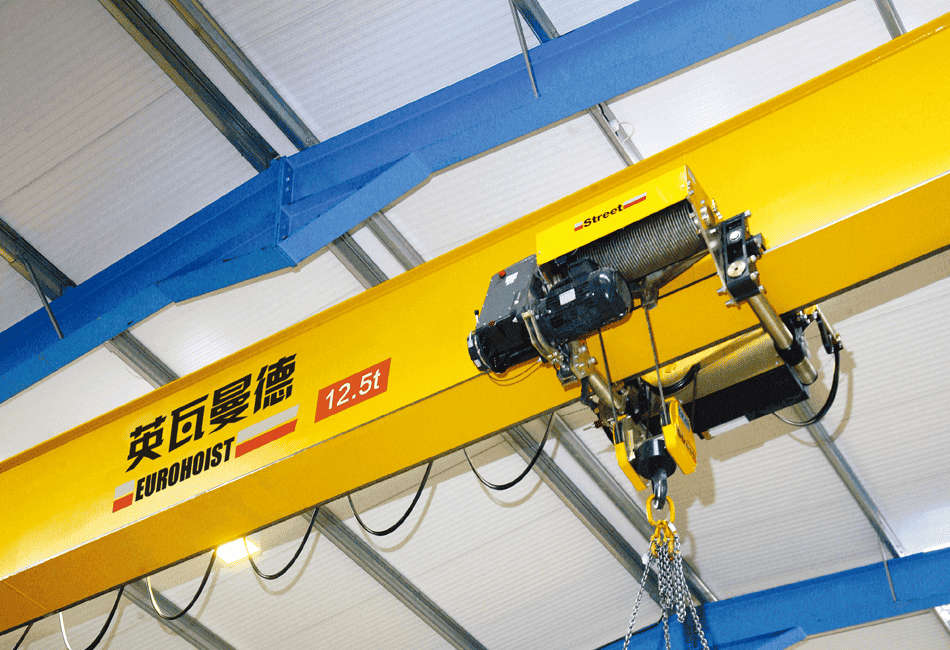
The applicable rated capacity of a single-girder overhead crane is usually 1-20 tons, with a span of 6-30 meters, and the structure is one main girder + electric hoist + end carriage travel mechanism. But before specific selection, five questions need to be answered first:
Question 1: What Is the Maximum Load to Be Lifted?
The rated capacity must cover the actual maximum lifted load and leave a margin. Common specifications range from 1 ton to 20 tons—machining workshops commonly use 1-10 tons, assembly lines commonly use 2-10 tons, and warehousing scenarios commonly use 1-5 tons. Note: if materials close to the rated load are frequently lifted, it is recommended to increase the working class accordingly, rather than selecting right at the upper tonnage limit.
Question 2: Are the Span and Lifting Height Sufficient?
The span (distance between the centerlines of the rails at both ends) is customized according to the actual workshop dimensions, usually 6-30 meters; the lifting height (from the ground to the highest hook position) is standard 6-12 meters and can be extended. If these two dimensions are chosen too small, the most awkward situation is discovering after the equipment is in place that it "cannot reach"—be sure to base this on measured drawings, not on rough estimates.
Question 3: Do the Usage Frequency and Working Class Match?
The working class (A3-A5) reflects the equipment's usage frequency and load condition: A3 is sufficient for maintenance workshops that use it occasionally; A4-A5 is recommended for assembly lines and processing workshops that run continuously every day. Choose too low and the equipment will not be durable; choose too high and investment is wasted. A simple criterion—how many hours per day does your workshop need to use this crane?
Question 4: Does the Workshop Have Sufficient Headroom?
This is the pitfall most easily encountered in existing workshop renovation projects. The lower chord height of the roof truss in old workshops is limited. If the clearance is insufficient, after a single-girder crane with a standard structure is installed, the actual lifting height of the hook will be severely limited. In this case, the European-style single-girder crane with a low-headroom design is the solution—by optimizing the main girder cross-section and end carriage structure, it achieves a higher hook lifting height under the same clearance conditions. Our lightweight design also places lower load requirements on the workshop roof truss and rails, and in many cases the rail beam does not need reinforcement.
Question 5: Are There Special Working Conditions on Site?
Explosion-proof requirements for chemical workshops, cleanliness requirements for electronics and pharmaceutical workshops, corrosion resistance requirements for electroplating and food workshops—these "special working conditions" must be integrated at the design source, and later retrofitting can hardly meet certification standards. If your workshop falls into this category, then during selection you should lock in a supplier with experience in special fields.
3. EUROHOIST Single-Girder Overhead Crane: Why Is It Worth Putting on Your Candidate List?
EUROHOIST has 80 years of crane manufacturing experience, has built a 30,000-square-meter production and assembly base in Huzhou, China, and has more than 500 employees worldwide, including more than 60 technical personnel. We have delivered a large number of single-girder overhead cranes for more than ten industries including machining, assembly lines, warehousing and logistics, automobiles, aerospace, and food. The following five capabilities are what we believe are most valuable to single-girder crane users:
Capability 1: European-Style Lightweight Design, Making It Easy for Existing Workshops to "Get On Board"
The single-girder crane itself is a representative of the lightweight category, and EUROHOIST has further optimized on this basis: the main girder uses Q355-B high-strength steel and computer-optimized box-type/section steel cross-section design, and the end carriage structure is compact—the overall machine has lower dead weight and smaller wheel loads, with stronger adaptability to existing workshop roof trusses and rails. For existing workshop renovation projects, this means that in many cases equipment with larger capacity or higher lifting height can be installed without reinforcing the rail beam; for new workshop construction, it means the roof truss and foundation can be designed to more economical standards.
Capability 2: Imported Quality + Localized Delivery, the Balance Point of Having the Best of Both Worlds
Our single-girder cranes use internationally leading brands for core transmission components (SEW geared motors, Siemens electrical components, imported wire ropes, etc.), and the complete machine is manufactured, assembled, and factory-tested at our Huzhou, China base—providing both quality consistency under European technical standards and the delivery time, cost, and after-sales advantages brought by domestic manufacturing. Compared with the long delivery cycles and remote maintenance of purely imported equipment, our spare parts warehouse is located domestically, enabling faster response and more controllable costs.
Capability 3: From Basic Model to Fully Automatic, the Same Equipment Can "Grow Up"
Not every enterprise needs full automation from the start, but most enterprises hope the equipment "will not become obsolete right after purchase." EUROHOIST single-girder cranes adopt a modular architecture:
Basic configuration: Variable-frequency drive, remote control operation, meeting daily efficient lifting needs;
Intelligent configuration: PLC control + precise positioning + anti-sway, enabling semi-automatic operation and reducing operational difficulty;
Fully automatic configuration: Supports industrial protocols such as Profinet/EtherNet/IP/Modbus TCP, connects with MES/WMS systems, and becomes a logistics node in the smart factory.
The basic model you buy today can be upgraded to the intelligent model tomorrow—without replacing the entire machine.
Capability 4: Full coverage of special working conditions, not just "standard products"
Leveraging our experience in demanding fields such as explosion-proof, cleanroom, and waste-to-energy incineration, our single-girder overhead crane can provide:
Working condition | Configuration points |
Explosion-proof workshop(chemicals/coatings/dust) | Explosion-proof motor, explosion-proof electrical box, reliably conductive hoisting components, whole-machine explosion-proof certification |
Cleanroom(electronics/pharmaceuticals) | Fully sealed structure, antibacterial and dust-proof coating, anti-static configuration, micro-vibration control |
Corrosive environment(electroplating/food/marine) | Corrosion-resistant materials, multi-layer anti-corrosion coating, sealed drive |
High-temperature/high-dust environment | Heat dissipation optimization, dust-proof sealing, increased protection rating |
Capability 5: Service network keeps equipment "usable for the long term"
Equipment delivery is only the beginning. We have established spare parts warehousing at our Huzhou base, and commonly used spare parts can be quickly allocated; our nationwide service team provides installation and commissioning, operation training, regular inspections, and emergency response; key components use internationally common brands, and users can also purchase replacements from the market themselves. We believe that the value of a single-girder overhead crane is ultimately reflected in every stable lift over its 15-20 year life cycle.
IV. Six-step checklist for single-girder overhead crane selection
Step | What to do | Key actions |
| 01 | Determine the lifting capacity | Determine based on the actual maximum lifting load + 10%-20% margin, and record the load range for frequent operations |
| 02 | Measure the span and lifting height | Base it on measured drawings, and note the constraint of the roof truss bottom chord height on clear height |
| 03 | Determine the working class | Determine A3-A5 based on average daily usage duration and load status; if unsure, choose one level higher |
| 04 | Confirm the operation method | Floor control/remote control/cabin control selected according to working conditions; remote control recommended with anti-sway function |
| 05 | Evaluate special working conditions | Explosion-proof/clean/corrosive/high-temperature, whether special configuration is required |
| 06 | Reserve expansion interfaces | Is it possible to connect to MES/WMS in the future, and do semi-automatic/full-automatic upgrades? Choose a modular architecture |
Organize the results of these six steps into a requirements specification, then conduct technical exchanges with suppliers—you will find that solution comparisons become much clearer, and quotations are more comparable.
V. Frequently Asked Questions (FAQ)
Q1: How exactly should one choose between a single-girder crane and a double-girder crane?
In one sentence: For common lifting loads within 20 tons and no special lifting requirements, choose a single-girder crane(simple structure, light dead weight, economical cost); For loads over 20 tons, heavy-duty work or complex lifting attachments, choose a double-girder crane. If your workshop may have larger lifting needs in the future, you can evaluate a double-girder solution at the time of selection to avoid the awkwardness of facing an upgrade shortly after the equipment is in place.
Q2: Can a single-girder crane really be installed in a low-headroom workshop?
Yes. The low-headroom solution optimizes the main girder cross-section and end carriage structure to gain a higher lifting position for the hook under the same workshop headroom. We have encountered many old workshops that "felt they definitely could not install one", but after on-site surveys, installation was achieved through lightweight low-headroom solutions. However, whether it can be installed and whether local reinforcement is needed must be based on the conclusion of the on-site survey—never place an order based on drawing estimates.
Q3: Is daily maintenance of a single-girder crane complicated?
Not complicated. The single-girder crane has a simple structure, and daily maintenance mainly includes: regular inspection and lubrication of wire ropes/lifting chains, torque calibration of brakes, oil level inspection of the electric hoist reducer, regular calibration of the crane runway (to prevent "rail gnawing"), cleaning of the electrical control cabinet and tightening of wiring. We provide operation training during installation and commissioning; 2-3 electricians/mechanics from the customer can handle daily maintenance after training. Key components use internationally common brands, and spare parts procurement channels are smooth.
Q4: How many years can a single-girder crane be used? What are the key factors affecting its lifespan?
Designed according to specifications, used and maintained normally, the design life of a single-girder crane is usually 15-20 years. Three key factors affecting actual lifespan: first, whether the load usage frequency matches the working class(overloading will accelerate metal fatigue); second, Rail installation quality(wheel-flange rubbing against the rails continually damages the wheels and travel mechanism); third, whether anti-corrosion maintenance is in place(especially in humid and corrosive environments). The equipment's own light dead weight and optimized structural design can also extend lifespan by reducing vibration and fatigue stress.
Q5: If I buy a single-girder crane now, what should I do if I want to connect it to an MES system later?
The key depends on whether the control system architecture is open. If at the time of purchase you choose a modular architecture with standard industrial bus protocols (Profinet/EtherNet/IP/Modbus TCP) + open data interfaces, subsequent MES/WMS integration requires only software interface development, integration and commissioning, with no hardware changes. With a closed control system, later modifications would be considerably more expensive and difficult. Include this requirement in the procurement technical annex and obtain the supplier's explicit commitment to open interfaces.
Q6: Why is there such a big difference in quotations for single-girder cranes?
The price differences in single-girder crane quotations mainly come from five aspects: The brand and configuration of the electric hoist(this is the largest cost component and also the core of reliability), The main girder structure and material(Q355-B high-strength steel vs ordinary steel), The electrical system configuration(variable frequency/non-variable frequency, remote control/pendant control, intelligent modules), Working class(the price difference between A3-A5 is significant), as well as Special configurations(explosion-proof, cleanroom, etc.). A lower quotation is not necessarily a better deal—for a crane that frequently breaks down, is difficult to control due to swaying, and cannot be upgraded, the downtime losses and efficiency losses over 15 years far exceed the procurement price difference saved.
EUROHOIST
80 years of crane manufacturing experience | Specialists in intelligent industrial lifting solutions
China production and assembly base: Huzhou High-tech Zone, Zhejiang | Factory area: 30,000 square meters
Product range: Light-duty and heavy-load handling, configured for the application | Single-girder/double-girder overhead cranes | Fully automatic cranes | Gantry cranes | Flexible beam light-duty cranes | Jib cranes | Explosion-proof/cleanroom/corrosion-resistant special cranes | Various electric hoists
Service fields: Machining | Assembly lines | Warehousing and logistics | Automotive manufacturing | Aerospace | Food industry | Electronics and pharmaceuticals | Chemical explosion-proof
Global partners: China National Building Material | Sinoma International | GE | Alstom | Hyundai (Korea) | Emirates Global Aluminium
Official website: www.EUROHOIST.com.cn