What exactly is the difference between a bridge crane and a gantry crane? A thorough explanation from structure to selection in one article
- Categories:News
- Publish Time:2026-08-07 15:26:27
Bridge cranes rely on factory building rails and are suitable for efficient indoor handling; gantry cranes are independently supported on the ground and are specialized for large-span outdoor scenarios. The key to selection is the site: choose bridge type if there is a factory building, gantry type if there is no factory building, and consider semi-gantry type for special needs.
EUROHOIST | 80 years of crane manufacturing experience | Specialists in intelligent industrial lifting solutions
1. The "overhead crane" and "gantry crane" that many people can't tell apart—the difference actually comes down to one sentence
On industrial sites, you often hear conversations like this:
"We need to install an overhead crane in the workshop."
"Do you mean the kind that runs overhead, or the kind with two legs on the ground?"
The confusion between "overhead crane" and "gantry crane" is essentially a matter of distinguishing between two types of equipment: overhead cranes and gantry cranes. They both belong to "bridge-type cranes"—both have a main girder, both have a trolley, and both lift materials within a planar area. Many first-time buyers stare at pictures for a long time and think they "look about the same," only to discover they chose the wrong type when the equipment arrives on site and can't be installed.
In fact, the difference between the two can be summed up in one sentence:
The bridge of an overhead crane is mounted directly on the tracks of the factory building; the bridge of a gantry crane stands on ground-level tracks via two legs (support legs).
The structural difference behind this one sentence determines that their usage sites, load-bearing methods, civil engineering requirements, and cost logic are completely different. This article will explain this difference thoroughly to help you avoid difficulties in selection next time.
2. Structural differences: one "grows inside the factory building," the other "comes with its own gateway"
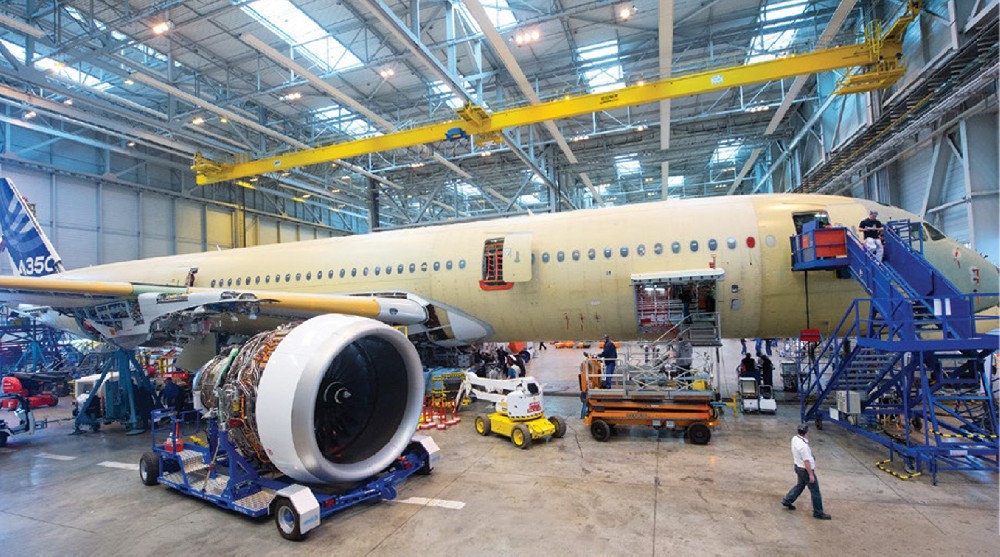
Overhead crane: the "aerial corridor" at the top of the workshop
The structure of an overhead crane (commonly known as a traveling crane or overhead traveling crane) can be divided into three parts:
Bridge: composed of the main girder and end girders, spanning the workshop span;
Hoisting trolley / electric hoist: moves laterally along the main girder;
Long travel mechanism: the wheels at both ends of the end girders travel longitudinally along the tracks on the factory building's track beams.
Its key feature is: the bridge is supported directly on the elevated tracks on both sides of the factory building. That is to say, the weight of the entire equipment is transmitted to the foundation through the factory building's columns and roof trusses—it "grows" inside the factory building and cannot do without the factory building's supporting structure.
This brings a significant advantage: it does not occupy the effective floor area of the workshop. The floor can be used for machine tools, material storage, and forklift traffic, with all handling completed overhead. Therefore, for any workshop with a factory building, an overhead crane is the most efficient aerial handling solution.
Gantry crane: an "independent gateway" with its own two legs
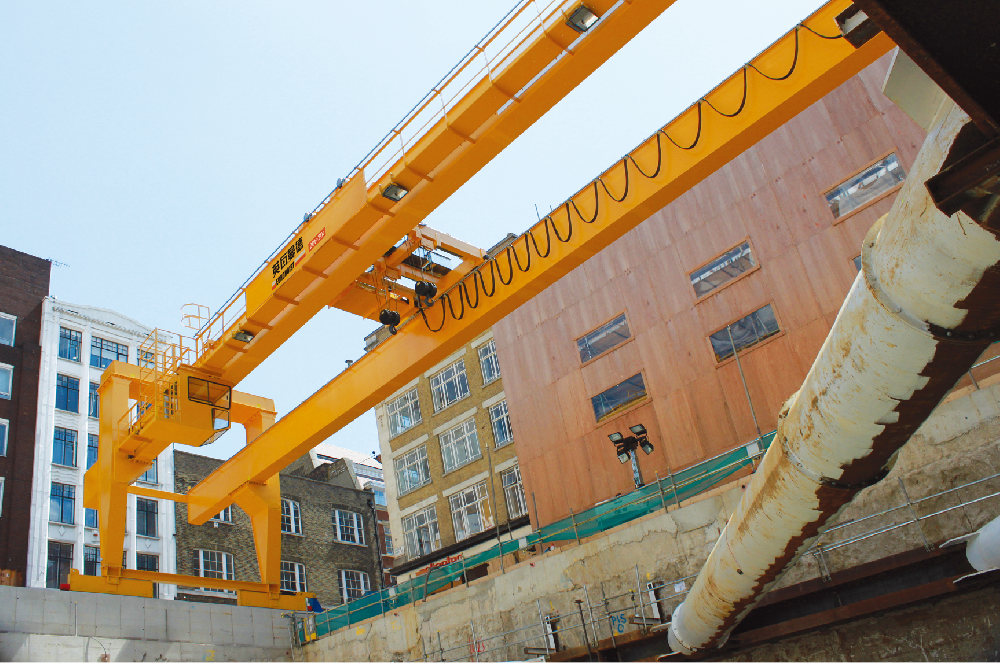
A gantry crane adds a critical pair of components to the bridge structure—support legs (the gantry frame):
The main girder is mounted on top of two tall support legs, with the overall shape resembling the shape of a gate;
The bogies and wheels at the bottom of the support legs travel longitudinally along tracks laid on the ground;
The load is transmitted directly to the ground through the legs, without relying on any building structure.
Because it "comes with its own gantry and stands on its own," it can operate in open-air sites without building support independently—steel stockyards, precast beam yards, docks, and shipyards are all the home turf of gantry cranes. The span can be made very large, and it can also span roads and low buildings.
Semi-gantry crane: the "compromise" between the two
Another type is the semi-gantry crane: one end of the main girder is supported on the building track (like an overhead crane), and the other end is supported by a leg on a ground-level track (like a gantry crane). It is suitable for sites with a building on one side and open or exposed space on the other, such as the outer wall line of a workshop or a loading platform—extending the lifting range from inside the workshop to outside the building.
III. Differences in application scenarios: look at the site first, then the load
When choosing between an overhead crane and a gantry crane, the first question is always: does your site have a building?
Scenario 1: Inside a workshop → overhead crane
Machining, assembly lines, maintenance workshops, warehousing workshops... as long as it is inside a building, the overhead crane is the mainstream choice. The building track beam is its "infrastructure"; overhead handling does not occupy ground space and covers the entire bay. The prerequisite is: the load-bearing capacity of the building roof truss and track beam must meet the requirements (European-style lightweight equipment has lower wheel loads, making it friendlier to existing buildings).
Scenario 2: Open-air storage yard/material yard → gantry crane
Steel stockyards, bulk material yards, precast component yards... without a building support structure, the gantry crane is the only feasible bridge-type solution. The load is transmitted directly to the ground track, the span can be tens of meters, and the entire yard is fully covered. Note the supporting open-air configurations such as wind protection and anti-corrosion.
Scenario 3: Spanning workshops and roads → gantry crane
When the lifting range needs to span workshops, roads, or low buildings, the high legs of the gantry crane can directly "step over" them. Ports and docks, hull block lifting in shipbuilding, and hydropower station hoisting are all typical scenarios.
Scenario 4: Both indoor and outdoor → semi-gantry or cantilever gantry
With a building on one side and open air on the other, or when lifting needs to extend beyond the workshop entrance—semi-gantry and gantry cranes with cantilevers can better fit the site layout.
A quick-reference table
Your site conditions | Recommended choice |
Indoor workshop, with building track beams | Overhead crane (bridge crane) |
Open air without a building, with ground space | Gantry crane |
Needs to span roads/buildings/large spans | Gantry crane |
Inside a workshop, under 20 tons | Electric hoist single-girder overhead crane (economical and flexible) |
One side has a factory building, one side is open-air | Semi-gantry crane |
IV. EUROHOIST: Complete bridge and gantry product lines, one-stop solution for both types of needs
Many projects actually require both types of equipment at the same time—installing an overhead crane in the workshop and a gantry crane in the yard. If a brand excels in both product types, procurement, technical coordination, and after-sales can all be managed uniformly, saving a lot of hassle.
EUROHOIST has 80 years of crane manufacturing experience, with a 30,000 square meter production and assembly base in Huzhou, China. Its products support light-duty and heavy-load handling, with rated specifications selected for the application. It offers complete product lines for overhead, gantry, and portal slewing cranes:
Overhead crane (bridge crane)
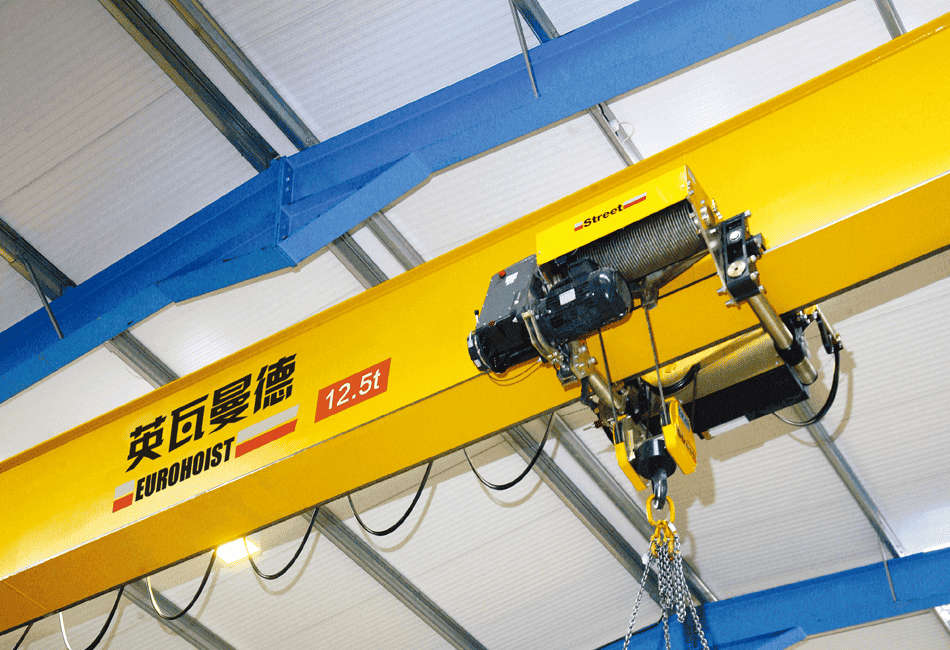
Single-girder overhead crane with an electric hoist: a standard choice for workshop loads under 20 tons, with a simple structure, low self-weight, and economical cost;
Double-girder overhead crane with an electric hoist or hoisting trolley: a reliable choice for heavy loads, frequent operation, and large workshop spans;
European lightweight design: Q355-B high-strength steel + compact structure, lighter dead weight, smaller wheel load, lower load-bearing requirements for the runway beam of existing factory buildings. Many projects can be installed without reinforcing the runway beam;
Low headroom solution: Old factory buildings with limited clear height can also achieve a higher hook lifting position.
Gantry crane
General gantry/semi-gantry/cantilever gantry: Covers open-air yards, precast yards, docks, shipyards, and other scenarios;
Large-span design: support legs + a split-drive structure, protection against skewing and rail binding, and a full wind-resistance configuration;
Special customization capability: Lifting capacity up to 250 tons SWL, working class M8 (CMAA Class F), supports advanced configurations such as multi-support, multi-span, slewing, suspension, visual recognition, etc., meeting demanding non-standard lifting needs.
Shared intelligent capabilities
Although overhead and gantry cranes differ structurally, they share core technologies such as hoisting, anti-sway, positioning, and control. EUROHOIST provides both types of equipment with a unified fully automatic control platform:
PLC fully automatic control, supporting mainstream industrial protocols such as Profinet/EtherNet/IP/Modbus TCP;
Anti-sway control + precise positioning, the load stops upon arrival and aligns accurately;
Can interface with MES/WMS systems, supporting remote monitoring and unmanned operation upgrades;
Solutions for special operating conditions: complete configurations for explosion-proof, cleanroom, and corrosion-resistant applications.
In other words, whether you choose an overhead crane or a gantry crane, you can obtain consistent quality, consistent intelligence, and consistent service support under the same technical system.
V. Four-step selection method: turn "choose bridge or gantry" into a fill-in-the-blank question
Step | Question to answer | Judgment direction |
| 01 | Is the site indoors or outdoors? Is there a factory building? | With a factory building → overhead; without a factory building → gantry |
| 02 | How heavy is the load, how large is the span, how high does it need to be? | Determine tonnage/span/lifting height/duty class |
| 03 | What are the operating frequency and load conditions? | Determine the duty class (A3-A8) and single/double girder |
| 04 | Are there any special requirements? | Explosion-proof/cleanroom/outdoor wind resistance/automation integration/future unmanned operation |
Write down the answers to these four steps clearly, then have a technical discussion with the supplier—you will find that the proposal comparison that originally "looked completely confusing" suddenly becomes clear.
6. Frequently Asked Questions (FAQ)
Q1: Which is cheaper, overhead or gantry?
It depends on the site. Workshops with a factory building: an overhead crane does not need support legs or ground-level rails and is usually more economical (especially a single-girder crane under 20 tons); open-air sites without a factory building: a gantry crane is the only option, so the question of which is cheaper does not arise. For the same capacity and span, a gantry crane generally costs more than an overhead crane because of its additional pair of legs and ground-rail foundations.
Q2: If I choose overhead now, what if I want to change to gantry later?
Technically it can be changed, but economically it is not recommended—it involves redoing structural calculations, rail design, and wind resistance verification, with costs close to a new custom build. A more practical approach is to select the model in one step according to the final site requirements. If the storage yard may be expanded in the future, the gantry rail foundation position can be reserved in advance.
Q3: The clear height of an old factory building is insufficient—can a crane still be installed?
In most cases, yes. The low-headroom design of European-style single-girder cranes optimizes the main girder cross-section and end carriage structure to achieve a higher hook position at the same clear height; the lightweight design results in lower wheel loads, which is friendlier to the rail beams of old factory buildings. But whether it can be installed and whether local reinforcement is needed must be based on an on-site survey—we provide free on-site surveys and proposal evaluations.
Q4: What should be paid special attention to for an open-air gantry crane?
Three points: wind protection and anti-slip measures (rail clamps/anchoring + anemometer interlock, a critical safety requirement), electrical protection (at least IP55, IP65 recommended for seaside locations), anti-corrosion coating (sandblasting + epoxy zinc-rich primer + polyurethane topcoat). Without these, the service life and safety of outdoor equipment will be greatly reduced.
Q5: Can both overhead and gantry cranes be automated?
Yes. The two share common technology in anti-sway, precise positioning, and PLC automatic control, and both can interface with MES/WMS and support remote monitoring and unmanned upgrade. When selecting, pay attention to two points: whether the control system architecture is open (whether it can interface with a host system without changing hardware), and whether intelligent interfaces are reserved.
Q6: What are the benefits of buying both overhead and gantry from one company?
Three benefits: unified technical standards (anti-sway, positioning, and control solutions from the same system, with shared operation and maintenance knowledge), simpler coordination (one technical team, one set of drawing specifications, and common spare parts), clear accountability (one after-sales contact, avoiding buck-passing among multiple parties). For projects requiring both overhead and gantry cranes, integrated procurement makes quality and costs easier to manage.
EUROHOIST
80 years of crane manufacturing experience | Specialists in intelligent industrial lifting solutions
China production and assembly base: Huzhou High-tech Zone, Zhejiang | Factory area: 30,000 square meters
Product range: Light-duty and heavy-load handling, configured for the application | Bridge cranes (single girder/double girder) | Gantry cranes (general/semi-gantry/cantilever) | Portal slewing cranes | Fully automatic cranes | Special custom cranes (250T/M8) | Various electric hoists
Service sectors: Machinery manufacturing | Automotive | Aerospace | Pulp and paper | Steel and aluminum | Power and energy | Waste incineration power generation | Railway transportation | Precast components | Wharf and yard
Global partners: China National Building Material | Sinoma International | GE | Alstom | Hyundai (Korea) | Emirates Global Aluminium
Official website: www.EUROHOIST.com.cn